

Survey Shows Americans Favor Alternative Ways to Combat Drunk Driving
In recent years, progress on reducing the number of drunk driving deaths has seemingly stalled. Alcohol-impaired driving consistently accounts for approximately a third of all traffic fatalities. In 2017 that translated to 10,874 fatalities from crashes involving drivers with a BAC of .08 or higher.
While there is no silver bullet to address drunk driving, critics suggest more could be done to make America’s roads safer. A recent survey by NORC at the University of Chicago, sponsored by the National Safety Council, asked U.S. drivers about their support for some underutilized traffic-safety strategies. In relation to drunk driving, the survey asked about attitudes toward lowering the legal BAC limit for drivers, use of sobriety checkpoints, and alternative sanctions for repeat DWI offenders.
Each respondent was given background information and research statistics on the strategies they would be evaluating so they could make informed judgments. Respondents were largely in favor of these strategies, with especially strong support for the measures to keep alcohol-impaired individuals from driving and to keep DUI offenders sober.
1. Sobriety Checkpoints
Decades of research has proven that checkpoints are highly effective in deterring drinking and driving. Widespread use of sobriety checkpoints could reduce fatalities by at least 8%. Adding passive alcohol sensors at checkpoints to detect alcohol-impaired drivers would increase detection by 50%. Only 12 states conduct sobriety checkpoints on a weekly basis, and several states have laws prohibiting the use of checkpoints.
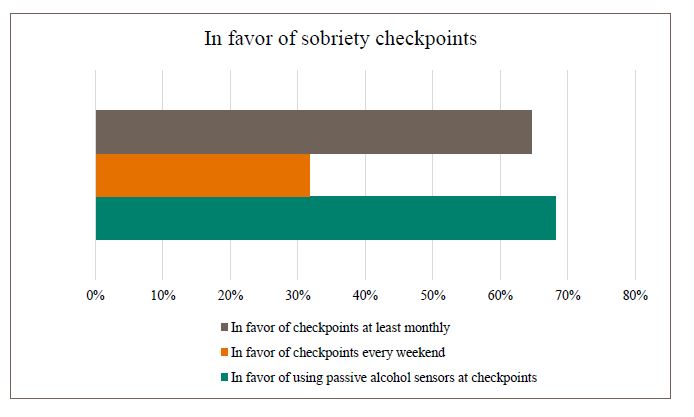
Almost a third of the survey respondents said that checkpoints
should be conducted every weekend in their community, with 64.7% of the respondents in favor of monthly
checkpoints. Of those surveyed, 68.2% were
in favor of police using passive alcohol sensors at sobriety checkpoints to
increase detection and enforcement.
2. Ignition Interlocks and Alcohol Monitoring Anklets
All 50 states
have some form of alcohol ignition interlock device laws, and installation of
the interlocks can reduce repeat offenses by approximately 70% while the
devices are installed. As such, it is not surprising that more than 80% of survey respondents favored
requiring all convicted DWI offenders to install an ignition interlock device
in their vehicles.
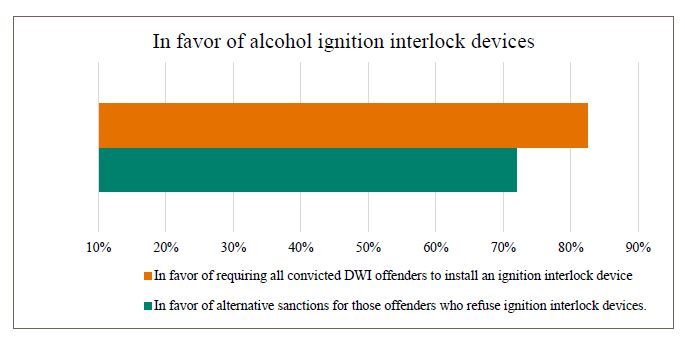
However, on average only about one-fifth of eligible offenders actually install the device on their car. In response, 71.9% of those surveyed were in favor of alternative sanctions—such as house arrest or required abstinence with an alcohol monitoring ankle bracelet—for convicted DWI offenders who refuse ignition interlock devices. Monitored sobriety has been shown to support long-term behavior change in repeat and hardcore drunk drivers—the individuals most likely to be involved in a fatal crash.
3. Lower Blood Alcohol Limit
Currently, 49 states have a BAC limit of .08, despite the National Transportation Safety Board (NTSB) recommendation that all states reduce the legal BAC to 0.05. Several states such as New York, California, and Michigan are considering .05 legislation, but only one state, Utah, has a legal BAC limit of .05.
Three-quarters of those surveyed said they had heard of BAC limits for driving and thought that drivers with a BAC of .08 or higher were a danger. When asked if they thought the BAC limit should be lowered to .05 in their state if the penalty would not be criminal but administrative such as a fine or license suspension, more than 57.5% were in favor.
Life-Saving Changes
None of these strategies have been widely implemented in the United States. This may be because of the public’s lack of knowledge of their effectiveness, and subsequently the lack of push to implement them. Along with current traffic safety enforcement measures, it is projected that putting these strategies into practice could significantly reduce traffic fatalities if implemented widely across the United States.
Note: There is a poll embedded within this post, please visit the site to participate in this post’s poll.
Source: Sobering Up Blog